0

A LONG LINE OF MILKMEN

milkHoward Benson’s a lovely man. He’s been the milkman in Adverse Camber ever since his uncle Albert’s eccentric behaviour crossed the line from ‘endearing’ to ‘Oh Good Lord’, necessitating his rapid removal to a comfortable and triple-locked place of safety.

In the normal course of events the milk business should have passed down the family line to Albert’s offspring, but as Albert never married nor – as far as anyone knew – ever showed the remotest interest in members of the opposite sex, he had no children. So it was that his nephew Howard donned the brown overall and gumboots and climbed into the milk van to ply his trade up and down the mean streets of Adverse Camber.

Uncle Albert was not a methodical man. He was, in fact, the antithesis of his brother Ronald. Their father William had spent a lifetime building up the Benson farming empire which encompassed milk and beef cattle plus a thriving dairy. On William’s death, Ronald took over the farm and Albert the dairy; but whereas Ronald ran his business with all the single-minded and ruthless efficiency of an eastern European dictator, Albert ambled through life pretty much making it up as he went along – to the extent, as Howard found out after his Uncle was taken away to be looked after by kind people, of never keeping any records of any kind. Not only did he not keep accounts, he didn’t have a list of customers written down anywhere either. He kept his money in the pockets of his voluminous and filthy overalls, decanting it into an assortment of tea caddies, shoe boxes and – yes – milk churns, only when he started shedding fivers like confetti up and down Main Street. His customers and their weekly requirements he simple kept in his head.

It has taken Howard almost two years to sort out the resultant mess, and he still occasionally comes across little stashes of bank notes rolled up and stuffed in unlikely and insanitary places.  I know this because he tells me so as he loiters hopefully in the kitchen door, dropping hints about kettles and digestive biscuits.

I know everything about Howard. He spares me no details of either his personal life or his medical problems. Shortish and tubbyish with thinning hair and a slight case of duck’s disease, he’s as clean and scrubbed as his Uncle was apparently foetid and encrusted and comes, he tells me proudly, from a long line of milkmen.

He’s an entirely harmless and obliging soul who quite literally wouldn’t hurt a fly. Unfortunately he also has absolutely no idea what the phrase ‘too much information’ means.

It’s my own fault, I suppose. I’m too polite not to listen to him telling me his troubles and too much of an bossy little know-it-all to be able to resist the temptation to offer advice – which only encourages him. So I’m intimately acquainted (so to speak) with his ‘waterworks’, his piles and his flat feet as well as his financial woes, his lack of a love life and how it wasn’t his fault when that bus rear-ended him at the Nether Camber roundabout.

One thing he has never been however, is forward. No smut, no innuendo, no suggestive nudge-nudging … he’s just a big shiny-faced human teddy bear to whom unfortunate things seem to happen on an astonishingly regular basis.

Yesterday, he turned up considerably later than usual: something I didn’t notice until I looked outside the back door to get the milk in, and it wasn’t there. I was just wondering if I should go down to the Post Office Stores to pick up a couple of pints when there was a diffident knocking on the door. When I opened it, there stood Howard, with his head bowed in a rather odd manner.

‘Sorry I’m late.’ He tried to look up, but didn’t get any further than where my cleavage would have been if I’d been wearing a low-cut dress instead of an old boiler suit. (I was painting the spare room – so shoot me, fashion fascists.) ‘Woke up this morning with this terrible pain in me neck.’

‘Have you taken anything for it?’

He stood there for a long moment without saying anything and, thinking he might have dozed off on his feet, I was just wondering whether I should poke him when he came to with a slight start and said, “Some pills of Uncle Albert’s I found in the bathroom cupboard.’

I felt my eyebrows trying to crawl up over my forehead.

‘What sort of pills?’

‘Dunno.’

Another silence descended and I half bent over to try and see his face. ‘What did he take them for, Howard?’

‘His arthritics, I think.’

‘You think?’

‘They seem to be working.’ Another silence as he stared at my bosom. ‘It’s better than it was, any road.’

‘Should you be driving?’

‘Oh I’m not. Eddie’s driving today.’

Eddie is Howard’s half cousin. (The Benson family tree is complex, with shadowy hints of intermarriage.) Eddie drives like a maniac even when sober, which he seldom is. I didn’t find the news that Eddie was driving encouraging and was digesting this new information when Howard unexpectedly continued:

‘I find looking at your bust very comforting.’

‘Er …’

‘I hope you won’t take that the wrong way.’

‘Of course not.’

‘It’s not a frightening bust, if you know what I mean.’

I glanced down at my denim-clad embonpoint, and tried to imagine what a scary bust looked like. I came up with a cross between Madonna and Boudicca, possibly with a bit of Brunhilde thrown in for good measure.

‘It’s a friendly sort of bust …’  He sounded almost wistful and was plainly about to expand on the subject even further when, to my considerable relief, the van horn sounded loudly from the road, where Eddie was getting impatient.

With a brief, ‘Nice talking to you,’ Howard shuffled off to startle the hell out of his next customer, leaving me and my friendly bust alone in the kitchen doorway feeling everso slightly bemused and wondering what, exactly, was in those pills that Uncle Albert used to take for his arthritics.

0

HOBBIT THROUGH THE WINDOW

window paintedI am, at heart, a Hobbit. Other people’s inspirational quotations tend to come from the likes of the Dalai Lama, Maya Angelou and Francis of Assisi. My own is from Bilbo Baggins:

We are plain quiet folk and have no use for adventures. Nasty disturbing uncomfortable things! Make you late for dinner!

Factor into the above that I’m of a somewhat stocky build with a mop of unruly wavy hair, dodgy dress sense and big feet, and it becomes unavoidable. No matter how much I may fancy myself as a Dúnedain Ranger, or a Wizard, or a Shieldmaiden of Rohan, the truth is that if I have to take my slippers off to do it, I probably won’t.

All of which is leading up to me saying that I’m the least likely person I can think of to be climbing in a total stranger’s pantry window and falling head first into a Belfast sink.

It started perfectly normally.

I was taking the dogs for a walk. There’s a really nice, not-too-strenuous three mile circuit from my cottage which goes down through Adam’s yard, up the other side of the valley, skirts Hangar Wood and then onto the Firs … a high expanse of sandy heathland that used to be an area of coniferous woodland until the timber was needed during the First World War and the trees were felled. Nothing now remains of the firs except a few stumps and the name, which has persisted, in that oh-so-British way, even though the origins of it are remembered only in folk memory.

From The Firs, if you can keep your feet in the almost continuous south-westerly gale that blows across it, you can enjoy wonderful views of the whole of the Camber Valley including Upper and Nether Camber and the inappropriately named Bellevue Brick Works: a blot on the landscape, but an historically important blot on the landscape and therefore okay.

The path down then takes you back into Adverse Camber via what is prosaically but accurately known as ‘Back Lane’ – a single track road with a few ancient cottages dotted along it which developers have never been remotely interested in because it spends most of the year in the shadow of The Firs and is, in any case, reputed to be slipping downhill at a rate of a couple of centimetres every century due to the ground water seeping through the sandy soil.

I was being dragged bodily down Back Lane by the Boy Dog, with the Old Girl plodding in the rear, when we were brought to a halt outside the cottage of Old Ma Farrish.

Ivy Farrish, to give her her proper name, has been an incredibly old lady as long as anyone can remember, and has forsworn aging in the normally accepted fashion to concentrate instead on shrinking by one inch each year, presumably with the intention of eventually just vanishing. She currently stands about 4’10”, and every inch of it was now standing in front of me, propped up on two walking sticks, in apparent contravention of all the known laws of physics.

‘I’m locked out,’ she announced without any preamble. ‘You can climb in the pantry window. I’ve put the steps there for you.’ She pointed stage left with her chin.

I peered around the corner of the wall in the direction she was indicating, and there, sure enough, stood a pair of battered aluminium steps beneath a small frosted window which I judged to be barely big enough to admit one of my legs.

‘Are you SURE you’re locked out?’ I asked, a touch desperately.

‘You’re a bit big.’ She eyed me disapprovingly. ‘But you’ll fit.’

‘Should I check the door? You know, just in case?’

‘I’ll watch the dogs for you.’

Feeling I was getting nowhere, conversation-wise, I was about to say that I’d tie the dogs up, because Boy Dog was a bit rumbustious, and she couldn’t handle him, when she scuttled forward like a huge spider, and snatched the leads from me.

‘Off you go then. Hurry up.’

I waited with my heart in my mouth for Boy Dog to drag her unceremoniously from her feet and vanish down the lane with her in tow, but to my utter disbelief he just sat down at her side to wait patiently, as if that was a perfectly normal reaction to being hijacked.

Outnumbered, I mooched over to the steps and peered unenthusiastically up at the window. It was a small casement window, and it was part open. Aware of three pairs of eyes boring into my back, I climbed up the steps, lifted the casement stay and opened the window fully. Immediately I realized that, unfortunately, Old Ma Farrish was entirely correct. I could just squeeze through, head first.

With a glance back over my shoulder, and praying that there was no-one around with a camera, I wormed my upper body into the pantry, then paused to look around. It was grim, dark and a bit smelly. Directly below me was a huge Belfast sink – cracked and stained and looking as if it harboured the bacteria of decades. I twisted around and looked above me for something I could get hold of to drag myself inside, but there was nothing beyond a rickety curtain pole – so I had no choice but to wriggle in, try to land with my hands in the sink and  hope a helpfully creative thought occurred to me on the way down.

It didn’t. My hand slipped and I landed in the sink with all the grace of a half hundredweight of coal, my neck at the sort of angle only Gustav Klimt could have dreamed up and the rest of me sprawled  over the draining board and halfway up the wall.

‘Ouch.’

With extreme difficulty, and fearing that no part of me would ever work properly again, I dragged my shoulder out of the sink, straightened my neck very carefully and extracted the remainder of myself from the various bits of the pantry it had landed on.

Then, hobbling pathetically around the cottage and bleating at intervals as parts of my anatomy complained about their treatment, I went in search of a door. Eventually, I found one. Unfortunately, it was not only behind a large dresser, but also nailed shut. Convinced that I’d fallen into the grip of a nonagenarian maniac, I was about to burst into tears when I heard peremptory hammering from the other side of the house.

‘What’s keeping you?’

The back door was actually only five feet to the left of the pantry window, but in my mildly concussed state, I’d completely failed to notice it. When I finally managed to wrestle the lock open, I found the old lady and the two dogs standing outside staring balefully at me.

She handed the leads back to me and kibbled inside, slamming the door on me with the finally benediction:

‘I hope you didn’t break anything in here.’

I limped slowly home, my back stooped and my head tilted to one side to ease the pain in my neck; and as I went I fantasized about waking up after a dark and stormy night to discover that Old Ma Farrish and her cottage had simply slithered down the hill into a sinkhole never to be seen again. She, of course. would be perfectly fine, but the Underworld would never know what had hit it.

0

MY HERO

sledgeEvery now and then one of those glossy magazines you find in dentists’ waiting rooms will publish an entirely inconsequential article about the pros and cons of living alone. The pros are always fairly obvious: you get to watch what YOU want on television, you can go to bed when you feel like it and can eat baked beans on toast without having to worrying about the social and physical repercussions. The ‘cons’ are usually equally unoriginal: no-one to share expenses with, no moral support with big decisions and no-one to soothe your fevered brow when you’re feeling a bit peaky. What I have never seen listed, however, is ‘No-one to help you when you’re trapped in the downstairs loo by a jammed lock.”
I wouldn’t have shut – still less locked – the door at all if it hadn’t been for the summer weather. For once, it was warm and sunny with a light breeze, and I’d thrown open all the doors and windows in order to give the house a bit of an airing. The downstairs loo (or ‘cloakroom’ as the estate agents so coyly put it) is just off the entrance hall: ‘To your left, past the aspidistra,’ as I say to visitors. Normally, with the front door bolted, I wouldn’t have bothered to close the door of the loo while I popped in for a quick wee, but I knew the postman was due and, as several of them are in the habit of dumping the post on the welsh dresser in the hallway if they see the front door is open, I thought it was prudent to close and lock the loo door for a moment or two.

The door opens inwards and is one of those substantial Victorian jobs made from inch-thick wood with D-shaped wrought iron handles on either side and a ball catch to keep it closed. At some point, much later in its life, someone had added one of those tricksy locks that doesn’t have a key but is operated by a little brass knob that you have to twist in unlikely directions to get it to engage. Getting in (with both dogs – who never allow me to go anywhere alone) and locking it wasn’t a problem, but when I tried to get out again, the little brass knob wouldn’t shift. I tweaked it. I wiggled it. I caressed it. I thumped it. I shook the door violently. Nothing. The knob didn’t budge. The dogs looked at me expectantly, sensing adventure in the air.

Forcing myself to stay calm, I sat down on the loo to consider my options.

I looked at the door. It was a very solid door that opened inwards so there was no point at all in throwing myself at it like a demented rhino because I would only succeed in dislocating my shoulder and providing a free floor show for the dogs.

I looked at the window. It was a very small window which allowed light and fresh air in, but was never designed as an exit, especially not for a 21st Century adult female of the well-upholstered variety.

I looked around for a heavy object to attack the lock with, but – being the downstairs loo as opposed to the tool shed – there was nothing more offensive available than a toilet brush, a bottle of pine disinfectant and some eco-friendly bleach.

And that, as far as my options went, was that.

I tried the door again, in the forlorn hope that all the jiggling, thumping and caressing might have had a delayed effect on the internal economy of the lock. It hadn’t of course, but human beings live in hope, so I resumed tweaking and shaking  until Boy Dog started to growl menacingly.

‘Oh no,’ I thought. ‘That’s all I need. Claustrophobia has driven him berserk and he’s going to attack me.’ But then I heard the unmistakable chink of the gate catch, followed a few moments later by a voice calling,

‘Helloooo!! Po-o-o-s-t!  I need a signature! Helloooo!!! Anyone ho-ome?!’.

Boy Dog, of course, went completely ballistic at the sound of the intruder – snarling and slavering as he scrabbled wildly at the quarry tiles. The Old Girl joined in enthusiastically from the comfort of the mat in front of the sink, and I was obliged to shout above the cacophony to make myself heard.

‘I’m stuck in the loo!’

‘What?’ The voice – that I identified as belonging to the postman everyone called Pat, but whose name was actually Terence – approached the door. ‘You’re in the loo? Do you want me to come back later?’

‘No! I want you to get me out!’

“What? You’re going out?’

Desperately, I grabbed the Boy Dog, whisked him off his feet and clamped my hand around his mouth. It didn’t stop him from barking, but it did reduce the noise to furious, wheezy grunts.

‘I said I want you to get me out. I’m stuck in the loo. The lock’s jammed.’

‘Oh.’ The silence of the completely non-plussed descended.

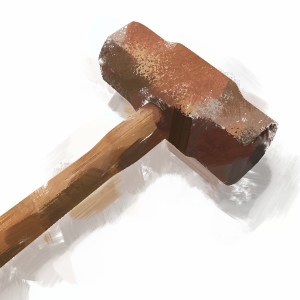
‘You’ll have to break the door down.’ The silence deepened. ‘There’s a sledgehammer in the shed around the back.’ I suggested helpfully.

‘Right,’ he replied, in the tone of a man who’d much rather be somewhere else. ‘I’ll go and fetch it then, should I? Back in a minute. Er – don’t go away.’

He was gone what seemed like a very long time, and I thought perhaps he’d decided to fetch help from the farm, rather than tackle the problem himself, but eventually he DID return and announced through the door,

‘Right. I found it. What do you want me to do?’

‘Aim at the area just below the handle. That’s where the lock is.’

‘Okay. Stand back, then.’

‘Standing back.’

Almost immediately, there was a heavy THUMP, which didn’t sound as if it hit the door.

‘Oops.’

‘What?’

‘I missed. Sorry.’

‘What did you hit?’

‘The door jamb. It’s a bit dented.’

‘Never mind.’ I took a deep breath, mentally started to draft the insurance claim and adjusted my grip on the Boy Dog. ‘Try again.’

His second swing connected, as did his third. At his fourth attempt there was a splintering sound and I saw the wood beginning to split. ‘One more should do it.’

It did. With a final effort, and plainly getting his eye in, he made good contact and the door shot open, slamming back against the wall in a shower of wood fragments, to reveal a red-faced Postman Pat clutching the sledgehammer like one possessed and looking thoroughly startled about it.

In my arms, the Boy Dog became completely apoplectic, while the Old Girl shot off the mat and straight out of the cloakroom to sink her single remaining tooth into one of our rescuer’s socks. He didn’t even seem to notice. He just put the sledgehammer down and looked at me a bit blankly.

‘Thank you very much,’ I said. ‘You’re an angel, Terence.’

‘You’re welcome.’ He blinked a couple of times as if to reset the day to Normal. ‘Could you just sign for this package then, please?’

0

SCHLICKETY-BINK ….

garageThere are, of course, both pros and cons to living in a rural community. The biggest ‘con’, unsurprisingly, is that everyone knows everything about you. If they don’t know it they try to find it out as soon as possible, and if they can’t find it out, they make it up. Gossip abhors a vacuum. If you meet a (male) friend for lunch in a remote watering hole ten miles away, it’s a major talking point in the local pub by evening. Furthermore, in the absence of any concrete information to the contrary, your lunch partner will be an old flame/your husband/your ex-husband/your best friend’s husband/your brother/your fancy man – depending on how lurid (or boring) the informant’s own internal life is. It’s the price you pay for fresh air and tranquillity – along with midges, rats and Victorian drainage systems. On the other hand, the biggest ‘pro’ is – well – that everyone knows everything about you. It’s virtually unheard of for people in small communities to lie dead in their house for weeks without anyone noticing. Most of the neighbours know your personal habits better than you do, and if you don’t turn up to collect your morning paper by midday, they’re sending the ghillies out. Nor do problems stay problems very long, because there’s always someone you can ask for help; and if they can’t help you themselves, they’ll always know someone who can (or possibly someone who knows someone – but it amounts to the same thing). Reliable local tradesmen are another bonus. True, punctuality and a pressing sense of urgency aren’t always well to the fore in their list of virtues, but when they do eventually turn up they do a decent job and they don’t rip you off. This isn’t necessarily because tradesmen in rural areas are inherently more honest or competent than those in urban areas, it’s because – as the local plumber said to me the other day while he was elbow-deep in my cistern – ‘Word soon gets around.’ The tradesman who overcharges and/or does a shoddy job in an area where the main means of communication are grapevines and smoke signals doesn’t stay in business very long. Which isn’t to say that you don’t often need industrial quantities of patience and a sense of humour: take my car for instance. It’s a solid, sensible and unremarkable vehicle that starts first time, trundles along gamely and isn’t a target for car thieves because no boy racer would want to be seen dead in it. I’ve had it for many years and every thud, rumble, click and squeak of its aging engine and chassis is an old friend to me. So when I started it up in the garage this morning and it began going ‘schlickety-bink, schlickety-bink, schlickety-bink‘, alarm bells rang. I know every single sound that car can make, and ‘schlickety-bink’ isn’t one of them. Very cautiously, I eased it out of the garage and into the road, expecting at any moment that something would fall off, explode or shoot through the bonnet. Then – when nothing unfortunate happened – I nursed it down the hill to the local garage.

Burdock’s Garage is housed in a large and dilapidated building which was built in the 1950s as a fire station, but never used as one. When construction was nearly completed, someone realized that the road at that point was so narrow the fire engine would have to do a five point turn just to get out, which – while immensely entertaining for the onlookers – would have been potentially devastating for the poor bloody householder whose bungalow was being incinerated. So the fire station stayed where it was, and the new building stood empty for several years until William Burdock Snr took it over on a temporary basis while his own premises were being refurbished after – you guessed it – a fire. When the refurbishment was complete, he decided that he didn’t want to move back, so he stayed put and rented his old premises to – you guessed it again – the Fire Service. So Burdock’s was at The Fire Station and the fire station was at Burdock’s and everyone was happy.

The fire station is long gone, but Burdock’s remains, patched up with an assortment of old doors and corrugated iron sheets and decorated with advertising signs which would probably valuable if they weren’t only held together by rust. William Burdock Jnr is one of life’s mysteries. He’s a cheery bloke who is forever wandering around with a mug of tea in his hand, talking to passers-by and never, apparently, doing any work. How does he stay in business? Well, he has a brother, known universally as ‘Big Gerald’, who is both a mechanic and part owner of the garage, but hardly ever seen during the hours of daylight. You work it out.

When I arrived at Burdock’s, William was, as always, outside with a mug in his hand. He beamed at me as I pulled up and wound down the window.

‘It’s make a funny noise William.’

schlickety-bink …. schlickety-bink …. schlickety-bink

‘What sort of noise?’

schlickety-bink …. schlickety-bink …. schlickety-bink

‘A sort of schlickety-bink sort of noise.’

He cocked his head to one side and listened intently for a moment.

schlickety-bink …. schlickety-bink …. schlickety-bink

‘Nope. Can’t hear anything. Hold on – let me get in the passenger seat.’

He clambered in, still clutching his mug, and repeated the head-cocking exercise.

schlickety-bink …. schlickety-bink …. schlickety-bink

‘Is it making the noise now?’ he asked.

schlickety-bink …. schlickety-bink …. schlickety-bink

‘Yes. It is …’

‘Are you sure?’

schlickety-bink …. schlickety-bink …. schlickety-bink

‘Absolutely CERTAIN, William.’ I realized that I was starting to clutch the steering wheel so hard my knuckles were turning white, and took a deep breath for the sake of my blood pressure. Still he looked bemused.

‘Is it a loud noise?’

schlickety-bink …. schlickety-bink …. schlickety-bink

Fortunately for my sanity, Big Gerald chose that precise moment to break the habit of a lifetime and emerge blinking into the sunshine, attracted either by my increasingly hysterical tone of voice or possibly by the schlickety-bink …. schlickety-bink …. schlickety-bink ….

‘Your engine’s squeaking a bit,’ he pronounced solemnly, after listening for a moment. ‘They do that, Zetec engines, when they get older. Not a problem.’

‘Can you fix it?’ I asked, desperately. ‘Like now?’

‘No need. There’s nothing amiss. They just do that, Zetecs. If it worries you, remind us the next time you book it in for a service. Mind you, it’ll soon start squeaking again, being a Zetec.’ And with that, still muttering about Zetecs, he disappeared back into the gloom,  presumably to carry on communing with his shock absorbers and differentials and what not.

I looked across at William who was still sitting in my passenger seat, unconcernedly drinking his tea and poking around in my glove compartment.

schlickety-bink …. schlickety-bink …. schlickety-bink

‘Can you still not hear it?’

schlickety-bink …. schlickety-bink …. schlickety-bink

‘Oh yes. I can hear THAT. I didn’t think that was the noise you were talking about. They do that, Zetecs.’

schlickety-bink …. schlickety-bink …. schlickety-bink

(Image from a photograph by Elade Manu, and reproduced under a Creative Commons licence

1

THE DOG WHO CRIED WOLF

coo2The Boy Dog has many excellent qualities. He is loyal, house-trained, easy to please and doesn’t (usually) wake me up when he crawls under the duvet at three o’clock in the morning. If pressed however, I would have to admit that he does have one tiny fault – and it’s one that’s endemic to Jack Russells.
He barks.

He barks at blowflies, passing crisp packets, dripping taps, the Old Lady Dog breaking wind in the next room, a butterfly landing on the window, a sheep sneezing three fields away – absolutely anything, and nothing, will trigger him. No extraneous sound is considered unworthy of his attention. The inevitable result of this, of course, is that whenever he starts barking, I just invite him to put a sock in it.

A couple of nights ago, when I was deeply immersed a rather lovely dream involving Daniel Day Lewis and a waterfall, the Boy Dog suddenly shot out of his basket, hurtled across my stomach and started barking dementedly at the window. Cross-eyed and startled, I threw a pillow at him and scored a pleasingly direct hit. However, apart from making him grunt, it had no discernible effect on him. He just carried right on barking. I made an uncoordinated grab for the alarm clock and tried to bring the wobbling, fuzzy numbers into focus. It was 4.15am.

‘It’s four fifteen in the morning,’ I bleated pathetically. ‘Do you HAVE to?’

The Old Girl raised her head to see what all the commotion was about, then went straight back to sleep. The Boy Dog barked some more.

‘Will you please, PLEASE be quiet!’

He paused for a moment, cocking his head to one side, in that distinctive way terriers have, as he considered my request. Then, to my relief, he nosed his way under the duvet and wrapped himself around my feet. As peace descended once more I settled back down under the covers to see if Daniel was by any chance still hanging around anywhere … but I never found out, because 10 minutes later, the Boy Dog started up again, this time from under the duvet. It gave the barking a sort of muffled, ghostly quality.

‘Do you want to go outside, boy?’ I asked him wearily, resigned to a broken night. ‘Is that what you’re trying to tell your stupid mum?’

At the sound of the magic words ‘go outside’, he shot from under the covers and stood quivering at the bedroom door, ready to rip things limb from limb. Boy Dog contra mundi, – or at least Boy Dog contra anything that happened to be in the garden, outside the gate or anywhere within earshot.

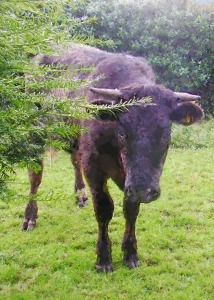
With an effort, I got up, pulled on my dressing gown and slippers and stumbled downstairs, with him dancing around my feet like a dog who’s just been told that sausages are on the menu. My plan was to  let him run around the garden several times at great speed – as is his wont – then haul him back indoors and go back upstairs to bed to sleep for a couple more hours. It was an excellent plan as far as it went, but didn’t take into account the cow outside the patio windows, eating my gazanias.

As it stood there on the crazing paving, chewing contentedly on the half-hardy annuals , I stared at it blankly, trying to cajole my still half-asleep brain into accepting what my eyes were seeing. Boy Dog, who was directly behind me, was MUCH faster off the mark. Screaming like a banshee, he hurled himself at the plate glass, wild-eyed and slavering, and a few seconds later he was joined by the Old Girl who’d woken up to find herself alone and come down to see what she was missing. When it became obvious to them that even acting in unison they couldn’t smash their way through the window, they decided that burrowing under it was the way forward – and that was when I decided they needed to be shut up out of harm’s way, and earshot, in an upstairs room.

With the barking reduced to a level that permitted coherent thought, I opened the back door and examined the problem in the garden more closely. A second cow was ripping up mouthfuls of crocosmias, a third was in my wildflower patch, a fourth had found my sunflowers … and after that I couldn’t bear to look, but a rough head count told me that there were approximately eight cows and calves in the back garden, all laying waste to the greenery. Then, as I watched, a hawthorn bush over on the field boundary began thrashing around in exactly the way that hawthorn bushes don’t, and the next moment, another cow ambled into the garden, dragging a mass of brambles and goosegrass with it.

I bolted for the sitting room and rang the farm. It rang and rang and rang  and no-one answered. I checked the clock. It was almost 5.00am. So much, I thought, for the old canard about farmers being early risers. I dialled again. Same result.

Wandering around the house with the handset, redialling over and over again, I opened the front door out of curiosity and was startled to find a large black cow directly outside, gazing back at me in mild surprise. I looked around. She was not alone. There were another six cows in the front garden.

I dialled the farm’s number again and this time just let it ring, determined to irritate Maggie into picking up. My garden was disappearing down her cows’ throats and she could bloody well wake up was my attitude.

Forty minutes after I first started trying, it was Alec’s voice that finally answered. I didn’t mess around  with courtesies.

‘My garden is full of cows.’

There was silence for a moment, then he said: ‘Your garden is full of cows?’

‘Yes. They’re coming through the back fence.’

‘Oh. Right. I’ll be right there.’

Nothing appeared to happen for a long time after that, and I cynically wondered if they were having a spot of breakfast before them came along … but then I spotted a yellow bucket being waved around in the hole in the hedge. It was being brandished by Alec, who was trying to entice the animals back out the way they came in, by means of a bucket full of calf nuts. My jaw dropped. The nearest cow edged closer, nose out … but then skittered off, crashing through my lavender bed as she went off in search of something better. I threw open the back door again in order to remonstrate with him, only to meet Maggie appearing around the corner of the house brandishing a broom. At the same time, the remaining stock in the field had got wind of the fact that there was a Man with Calf Nuts in their midst, and had started to gravitate towards him – slowly at first, but picking up speed as it became a race to see who could get there first.

‘Alec!’, she bellowed. ‘There are another half dozen of the buggers around the front … go and get Jimmy out of bed, we’ll have to herd them out ….’

She looked at me sheepishly.

‘Sorry. They should have been moved to another field by now, but we’re behind with the silaging because of the weather …’

‘Can’t be helped.’ It seemed churlish to complain about a few mangled and munched plants, a massacred rockery, a lawn like a ploughed field, a wrecked back fence, and several yards of splintered path edging. ‘No serious damage done.’

‘We’ll round them up and fix the fence.’

‘That’s fine Maggie. No worries. These things happen.’

A quarter of an hour later, the front gate closed on the last retreating cow backside and normality was restored.

It was six forty-five am. Upstairs, the dogs were still barking hysterically. I surveyed the mangled remains of my garden and decided that there was really only one thing that would make it all better again.

A  nice, hot, cup of tea.

0

THE MAN WHO ISN’T THERE

tractorToday, I met a man who doesn’t exist.

‘That’s one for the diary,’ I told myself as I watched him unloading logs into my lean-to shed, and thought he was pretty chunkily built for a wraith.

It all started when the mid-summer weather (leaden skies, wind and rain) reminded me that I should really be giving some thought to the coming winter and laying in oil, coal and wood for the boiler and the fire. So I wandered down the road to Joey and Mrs Fitt at ‘Conifers’, who always had a mountain of very precisely stacked firewood around the sheltered side of their house.

Joey was out, somewhat to my relief (perfectly nice man, but talks a lot, most about his tomatoes), but Mrs Fitt was in her kitchen cooking up chutney. I knew she was chutney making before I got anywhere near the back door because the smell of vinegar and spices drifting from the windows were starting to eat into the mucus membranes of my nose as I came through the gate.

Mrs Fitt presumably has a first name, but I have no idea what it is, because everyone, including husband Joey, just calls her Mrs Fitt.  She’s a friendly soul: a bit world-weary and frayed around the edges after years spent caring for her husband and their five hulking sons, but always helpful and welcoming.

‘Firewood? You need Adam. He’ll see you right.’

‘That’s great. Where do I find him?’

‘Lower Slaughter.’ She saw the look on my face and allowed herself the ghost of a smile. ‘Out of the village, up the hill, then take the unmarked lane on the left. It’s right down in the valley. I’d walk if I was you.’

‘Isn’t he on the ‘phone?’

‘No, he isn’t … And make sure you have some cash. He doesn’t take cheques.’ She turned her attention back to the bubbling pan on the hob for a long moment, then added mysteriously, ‘He doesn’t give receipts, either.’

Lower Slaughter, once I’d found the unmarked lane and slithered down the hill to the bottom of the wooded valley, turned out to be a picturesque dump of a place with tumbledown outhouses, collapsing fences, a weed-choked cobbled courtyard and a sturdily built farmhouse with thick walls and a roof that looked to be only just the right side of weatherproof. Everywhere you looked there was rusting farm machinery festooned in bedstraw, empty zinc buckets dumped in the long grass and tractor tyres apparently discarded where they fell which provided snug retreats for the chickens and geese that were apparently roaming at will. The tiny front garden of the house was a forest of rotting corrugated iron and barbed wire.

Feeling a bit uncomfortable and fish-out-of-waterish, I called out nervously, ‘Hello? Anyone home?’

There was no response. I tried again, with the same result.

Across the courtyard, through a gate that was hanging on by one hinge, I saw that the front door of the house was ajar, Cautiously, and keeping a wary eye on the geese, I eased the gate to one side and gently pushed the door open.

‘Hello? Adam? Are you home?’

Nothing. The interior of the house was gloomy.The small windows, designed to keep cold out and heat in, allowed very little light into the room, but the back door was open wide and I could just about make out an ancient cooking range on one wall, the tall bulk of a massive welsh dresser on another and a white wood table in the centre laden with pots, pans, crockery and a cat: a huge ginger cat which was curled up in the fruit bowl and glaring at me balefully.

I tried one more time.

‘Adam?!’

To my relief, there was an answering hail from the back garden.

I briefly debated with myself whether it was better to retrace my steps and go around the outside of the house or simply cross the gloomy room to the back door; but remembering the obstacle course in the front garden, I voted for the latter option and headed for the open door, praying that the cat didn’t smell the dogs on my clothes and decide to exact revenge on me on behalf of all cat-kind. It watched me with  a decidedly malevolent gleam in its amber eyes, but I made it to the door unmolested and escaped into the back garden.

What I saw there stopped me in my tracks.

After the war zone at the front of the house, what lay behind was simply unbelievable. Before me was laid out, with mathematical precision, an immaculately cared for and thriving fruit and vegetable garden. Green beans on bamboo frames ran the length of the plot; potatoes, carrots, peas and much else besides burgeoned in the weed-free beds at the front, in the middle were raised beds of salads and herbs and I could just make out raspberries and loganberries ripening in the fruit cages at the back.

And in the midst of it all stood a sturdy, weather beaten man in old but clean tweeds and wellington boots. His dark curly hair was greying, but he could have been anything between forty and sixty.

‘Yes petal?’

I found my voice. ‘Mrs Fitt said you could sell me some logs.’

‘I certainly can. You’re the lassie from Tigh-na-Mara, aren’t you?’ He grinned. ‘The house by the sea.’

‘Also known as Puddle Cottage.’ A bit non-plussed I smiled ruefully back at him as he stumped towards me in his boots, holding out his hand in greeting.

‘Pleased to meet you,’ he said as we shook hands. ‘I’m Adam. The logs are around the side.’

They were in a clearing in the woods, in an open-fronted barn and neatly arranged in order of age: the green logs on the right and the seasoned on the left.

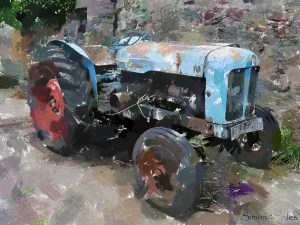
We agreed a price for a trailer load of seasoned logs, money changed hands and no receipt was offered. He promised to bring them up to me in a couple of hours, and indicated a pile of junk by the side of the barn which, on closer inspection, proved to be the oldest tractor I’d ever seen in my life. Walking me back through the house he waved me on my way up the hill and I headed for home feeling as if I was emerging from an alternate universe.

Needless to say, I wasted no time in pumping Maggie for information about him.

‘Adam?’ she said, inspecting the fruitcake for mould before offering it to me. ‘Adam is the man who isn’t there.’

‘Eh?’ I watched her putting the kettle on the hob and felt my brow furrowing. My brow furrowed a lot when I was talking to Maggie, I found. ‘What do you mean?’

‘That farm – if you can call it a farm – has been in his family for generations. His parents were living off the grid before the term was even invented. When Adam was born, they didn’t register his birth. As far as anyone knows, H M Government is totally unaware he even exists. He doesn’t pay taxes, claim benefits, fall ill or vote. He lives on what his parents left him and what he makes from selling logs, garden produce and odd-jobbing. Anything you want doing, Adam’s your man.’

‘And nobody’s ever ratted on him?’

‘He’s our secret. We look after Adam. And Adam looks after us. ‘

‘For cash only.’

‘Precisely. But a word of warning – that psychotic cat of his thinks it’s a rottweiler. If you go in the house alone when he isn’t there, you’re spaghetti.’

I nonchalantly picked a bit of mould she’d missed from my slice of cake, and examined it closely on the end of my finger. ‘I’ll bear that in mind,’ I said casually, feeling the sweat trickling down the back of my neck. ‘If I’m ever in the house alone with it.’

(Image based on a photograph of an abandoned tractor in Northumberland courtesy of Swalophoto on Flickr, under a Creative Commons Licence.)

0

I Bark, Therefore I Am.

guardianMy attitude to gardening isn’t so much laid-back as completely supine. If a sunflower seeds itself in the rockery, I leave it to do its thing in peace. If a poppy sprouts from that crack in the patio I never got around to filling in, then I grow a poppy in my patio. Moss, daisies and dandelions in my lawn worry me not – after all, they’re all green when they’re mown.

My laissez-faire attitude extends to the local wildlife. I feed the birds. I knock holes in the bottom of my fence panels so that the hedgehogs can rampage around unhindered. I even smile benignly upon the rats in the meadow, the wasps building their nest around the back of the old pigpen and the mammoth spider in the outside loo.

Recently, however, I haven’t been feeling the love towards rabbits.

I have a garden full of green stuff they can eat. I grow clover around the pond for the bees. I have wild borders and uncultivated tracts absolutely bulging with yummy bunny fodder, but what is it I’ve been finding dug up and nibbled back to a leafless stump every morning? My lovely, jolly marigolds and my ‘hides a multitude of sins’ nasturtiums.

I tried dangling old CDs from strings between bamboo canes, to twist and glitter in the sun and frighten the simple-minded: they sneered at them. I tried festooning the beds with black nylon thread entanglements to startle and confuse and convince them they’d be better off feeding somewhere else: they just blundered straight through them and then, to add insult to injury, left the thread lying invisibly on the lawn so that it snarled itself around the mower blades.

Finally, broken by the sight of my third seeding of nasturtiums being treated like cut-and-come-again salad by the buck-toothed little sociopaths, I let loose the dogs of war. Why keep Jack Russells and not expect them earn their tripe mix and choccy drops? That was my new, murderous mantra. The moment I spotted so much as a twitching nose in the undergrowth, I yelled “RABBITS!” and flung the back door open.

With most Jack Russells, instinct cuts in as soon as they see/hear/smell/even half way suspect the presence of a prey animal; they take off, a little hairy blur of legs and teeth, and deal instant death to any small furry intruders foolish enough to dawdle in their flight path.

My two, however, aren’t most Jack Russells. The Boy Dog gets so over-excited that his nose shuts down and his brain turns to mush. He hurtles out of the door, barking wildly, then rockets off in completely the wrong direction. And even if he does accidentally get anywhere close to a rabbit, he just shoots straight past it –  a bug-eyed berserker high on adrenaline. To make matters worse, the rabbits seem to know. Instead of running for their lives, they just hop into the long grass until he’s exhausted himself and collapsed into a panting, slobbering heap on the patio – and then they carry on as if nothing untoward has happened.

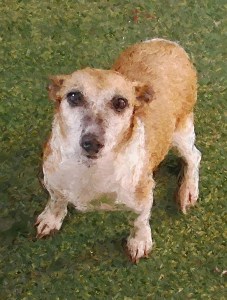
On the other hand the Old Girl considers it beneath her dignity to chase anything. Her response to the cry of ‘RABBITS!’ is to stand outside the back door for a few moments watching the Boy Dog going bonkers, then   sedately trot down the steps and around to the front of the house to bark at the gate. She doesn’t bark AT anything, you understand. She just barks. It’s what she does. When she finally goes off to the Great Kennel in the Sky, I shall write the words “I bark, therefore I am” on her gravestone.

The locals are so used to hearing me yelling at her to be quiet that one small girl is firmly convinced I have a dog called ‘SHUT UP’. I know this because when she goes past the gate with her mother, she greets the Old Girl cheerily with the words ‘Hello Shut Up’.

Today, it being warm and sunny, I was out in the garden in a death grip with the goosegrass that’s threatening to strangle my carefully nurtured blackberries. The dogs came out with me. The Boy Dog soon became bored with following me around – especially as I wouldn’t let him eat, chase or destroy anything – and retreated to the house to lie in the utility and look mournful. The Old Girl, however, loves nothing better than wrapping herself around my feet so that she can stick her nose where it isn’t wanted and then complain piercingly when she gets stepped on or kicked; and that’s where she was, or at least where I thought she was, when I spotted a furry intruder in the nasturtiums. In broad daylight. Not five yards from me. Eating my garden.

‘Rabbit,’ I said to the Old Girl. ‘RABBIT!’

Nothing happened. I looked down. She wasn’t there. I looked around and eventually spotted her over by the summerhouse, digging up my marigolds.

‘Nooooo!!!’ I screamed at her. ‘Traitor!!!’

She lifted her head briefly to gaze up at me, then, apparently deciding that I wasn’t offering her any food, carried on digging. The Boy Dog appeared at the back door, attracted by the commotion.

‘RABBIT,’ I bellowed at him. ‘RABBIT!!’

And he hurtled off in the wrong direction.

1

Audrey

rolling pinEvery village has an Audrey. They are women who have long since passed ‘a certain age’ and are yomping defiantly towards their twilight years unbloodied, unbowed, terrifying in their certainties and not to be trifled with under any circumstances, especially if alcohol has been taken. They have been through a world war, multiple recessions, innumerable hideous gynaecological procedures and several husbands (not necessarily in that order) and nothing, but nothing, fazes them. Not even, as it turns out, two tonnes of steel.

I first met Audrey shortly after I moved in. She cornered me one day in the Post Office Stores, backed me up against the tinned goods and proceeded to grill me about my personal circumstances: where I’d come from, why I’d come to Adverse Camber, my church-going habits, my willingness to join the WI and my taste in dogs.

‘Jack Russells. Can’t abide them, Nasty, yappy beasts. Keep them away from my Rosebud.’

‘Rosebud?’ I glanced pleadingly across at Isobel Buchanan, behind the counter, hoping to be rescued in my hour of need, but she was plainly enjoying the floor show far too much to intervene. ‘Is Rosebud your dog?’ I guessed, desperately, assuming that it wasn’t a sledge.

‘Rosebud,’ Audrey informed me imperiously, ‘Is a pedigree shih tzu.’

‘Bless you … I mean, gosh, how lovely.’ I cringed as she rammed her face up close to mine, her heavy French perfume smothering me with its expensiveness. ‘Sweet little dogs, shihs tzus.’ I gushed. ‘Look exactly like floor mops.’

I knew it was the wrong thing to say, but I always babble incoherently when my brain shuts down. It’s what comes from reading too much P G Wodehouse as an adolescent.

Audrey seemed to swell to twice her already considerable size.

‘She does NOT look like a floor mop!’

‘No of course not. Sorry.’ I grabbed desperately at a tin of something on the shelf. “Terribly nice talking to you, but I have to rush. I was in the middle of making soup and found out that I’d run out of …’ I glanced at the tin in my hand. ‘Prunes.’

‘You put prunes in soup?’ Isobel asked in mock innocence.

‘It’s a new recipe. From Turkey. Or somewhere. Pay you later. Okay?’

Fleeing for the door without waiting for an answer, I hauled it open and nearly had the air sucked from my lungs by a passing logging lorry; but fear – and the knowledge that Audrey’s eyes were drilling into the back of my head – made me reckless and I flung myself onto the narrow pavement like a madwoman – straight into Jazz Ruskin’s surprised arms.

‘Good Lord. What’s wrong? You’ve gone a really funny colour.’

‘I’ve just met Audrey.’

It was all the explanation she needed. She scooped me and my tin of prunes up and conveyed us to the Vicarage for a soothing cup of coffee and a rock cake.

Since then, I’ve managed to avoid Audrey. It isn’t a hard thing to do, because you can always hear her well before you see her and, funnily enough, when you step for a moment into the doorway of the hairdressers, or the graveyard, or the children’s play park, you’ll nearly always find someone else there, just hanging around nonchalantly admiring a hair style/ the stonework/that wildflower/their fingernails.

Last night, however, our paths crossed again in circumstances that dramatically altered my opinion of her.

It was about 1.30am and I was dreaming that Spitfires were hurtling past my window at regular intervals, filling my room with sound and light.

Va-voooom …………. Va-voooom ………… VA-VOOOOM …………

The last one woke me up. I sat bolt upright in bed realizing that they weren’t of course Spitfires, but cars: cars travelling at speed past the house, once every few minutes.

Hauling on my tatty dressing gown and slippers I stumbled downstairs and outside, arriving at the front gate just in time to see another one shoot past. and in the light from the porch, I caught the flash of a number on its side. It was plainly a motor rally of some kind – but through Adverse Camber? In the middle of the night? Now, I’m a placid sort of person really, but there are one or two things guaranteed to make me cross and one of them is having my sleep disturbed. Grabbing a torch from just inside the front door, I stepped out into the road, ready to do battle with the next oncomer, only to be forced to throw myself into the hedge as it nearly clipped me on the way past.

It was as I was dragging myself out of the shrubbery and pulling twigs from my hair that I realized there was a bit of a traffic jam further down the road: the rear lights of numerous cars were stacked up behind each other glowing redly in the dark and I could hear raised voices – the most dominant of which was Audrey’s.

As I wandered down the hill to find out what was happening, yet another car passed me, then screamed to a halt at the sight of the log jam ahead. The front seat passenger wound down the window and peered firstly down the road, then at me.

‘What the hell’s going on?’ he demanded.

‘That’s funny. I was going to ask you that.’

‘This is messing up all our times …

‘It isn’t doing a lot for my sleep, either.’

I left him to seethe impotently, and ambled down to join the substantial group of people that had gathered just outside the church. The villagers were dressed in a motley collection of nightwear while the rally drivers were in one-piece overalls, and they were all annoyed. The Police, I was informed, had been called. The drivers and their navigators were saying they had permission for the time trial. The Parish Clerk was saying ‘Oh no you don’t.’ And, magisterial in the midst of it all, gleaming magnificently in the headlights, was Audrey. In slippers with pom-poms, her hair in curlers and a rolling pin in her hand, she had single-handedly brought the event to a screeching halt by simply standing in the middle of the road, certain of her own invincibility, and refusing to blink first. The car had stopped within inches of her knees.

In a straight contest between Audrey and a rally car, the outcome had never been in doubt. It was only after the Police had arrived and were trying to separate furious villagers from aggrieved motor sports enthusiasts that I noticed the dent in the bonnet of the lead car. It was the sort of dent you’d expect to see if someone had hit it really hard with a rolling pin.

0

Of Bulls and Bluebell Burgers.

bluebell‘Do you know your bull is eating my rosa rugosa?’ I said to Maggie-the-Farmer across her kitchen table, after chasing Bovine Boris off my front hedge yet again.

She smirked irritatingly over the piece of beef she was wrapping and labelling. ‘You hum it and I’ll play it.’

‘Oh har-bloody-har …’

‘But he’s not my bull. He’s Ronald Benson’s bull. I just borrow him for the girls.’

‘Ronald or the bull?’

She raised a silently disapproving eyebrow and pushed the plate of rock cakes across to me. ‘Just biff him on the nose. He’ll soon get the message …’

The first time I had the questionable pleasure of making Bovine Boris’s acquaintance I was outside my front gate dragging goosegrass out of the rose hedging and wondering if I could eat it. Out of the corner of my eye, I saw a huge something lumbering down the lane towards me, and when I turned my head to look properly I found myself eye-to-nostril with the most enormous brown and white bull I had ever seen in my entire life. It was as wide as it was tall and you could have eaten a meal off its massively broad forehead.

I peered carefully past it up the lane, looking for an accompanying human, but could neither see nor hear anyone; which is when I started to back, v-e-r-y carefully, towards my gate. Once safely inside the house, I grabbed the ‘phone and rang Maggie.

‘There’s a bull. Outside my gate. What do I do?’ I wailed.

‘Introduce yourself,’  she replied – rather unhelpfully, I felt. ‘That’s Boris. He likes having his nose scratched.’

‘There’s no-one with him.’

‘No. We just let him out and he finds his own way home. He’s harmless. Big dafty, really … especially when he’s been in with the girls.’

Since then, I’ve got used to seeing Boris wandering around, but his fondness for my roses is threatening our budding inter-species understanding. The first time he started munching on them, I tried a few ineffectual ‘Shoo’ noises. The next time, I was braver and actually left the safety of my garden and laid hands on him in an attempt to push him away. I’d have had more luck shoving a pile of bricks – only a pile of bricks wouldn’t have stepped on my foot.

And so it was that I limped up to Maggie and found her at her kitchen table, along with Alec, her farmhand, surrounded by chunks of recently butchered beef and mountains of polythene bags.

‘Biff him on the nose? Is ‘biff’ a farming term, then?’

Alec snorted, reaching for another bag. ‘They have very sensitive noses. Maggie’s right. He’ll get the message.’

‘And he won’t charge at me or anything? Only in a straight contest between Boris and my hedge, I know who’d win.’

‘Bulls are very placid creatures,’ Maggie explain patiently. ‘Not to mention lazy. He’ll just look reproachful and go home.’ At that, she dumped a large bag of beef offcuts in front of me. ‘Here. Put that in your freezer. There’s plenty to go round.’

‘Ooh gosh, how lovely. Are you sure?’ ‘Of course. If you ever grow anything in that God-forsaken wilderness you call a garden, you can bring me your firstborn.’

‘In that case, thank you very much.’ I clutched the package gratefully to my bosom, suddenly feeling much more kindly disposed towards country living, and was about to head back to the cottage when I remembered that the last time I’d been at the farm, the local vet had been there, tending to one of Maggie’s cosseted and much-loved milkers. Bluebell, I was told, had ‘lost another quarter’.

‘By the way,’ I asked, ‘How’s Bluebell?’

Maggie and Alec looked up at me with identical crooked smiles on their faces, and then their eyes came to rest on the meat in my arms. ‘She’ll make lovely burgers,’  said Maggie, consolingly.

0

Christmas in summer.

stupid sockAll I want is a washing machine that washes clothes. Is that too much to ask?

It needs three programmes:

(1) Ordinary stuff.

(2) Putrid stuff.

(3) Almost clean stuff that just smells a bit funny.

For years, my mum had a twin-tub. You washed the clothes in the big tub and when they were done, you dragged them out with the wooden washing tongs and dumped them in the little spinning bit. Then you either held on like grim death or got out of the way while the whole thing waltzed all over the kitchen. Her washing was always spotless.

Now you need a qualification in differential calculus to operate the bloody things. I finally bought one of the most uncomplicated models on the market, and it still has 16 programmes, 12 of which I don’t even understand, let alone have any intention of using. I have, however, worked out which ones are ‘Ordinary’, ‘Putrid’ and ‘Just smells funny’ so those are the three I’ve marked with a felt tip pen.

None of which is anything to do with what I want to say – it’s just sort of a generalized drive-by whine.

I am here today to ask a favour.

If you ever hear me saying ‘I’ve volunteered to help at the local Summer Fayre’, would you please throw a tarpaulin over me and nail it down at the corners.

It was all Maggie-the-Farmer’s fault. There she was, standing on my newly washed utility floor in her cow-muck encrusted gumboots, saying “You will help out with the Summer Fayre, won’t you?  I’m organizing the Craft Stalls this year and I thought I’d better get in first before anyone else nabbed you.”

I was so busy bleeding inwardly about the mess she was making on my beautiful floor that I would have agreed to almost anything just so she’d take her gumboots somewhere else – and that’s why I spent a large chunk of today in the Church Meadow, standing behind a wobbly trestle table, trying to sell handmade Christmas baubles to people stuffing ice cream in their faces. In the drizzle. In June.

It was, theoretically anyway, a covered stall, but the cover had long since become more theory than fact, and had been supplemented over the years by a variety of plastic carrier bags, pieces of agricultural polythene and bin liners, all held together with duct tape. The effect was more shanty town than Thomas Hardy, but it did go very nicely with the bunting which, my neighbouring stallholder told me proudly, had been made by the ladies of the WI, to save the village money. It saved on colour and pzazz too, being composed almost entirely of material from old suits and shirts in varying shades of grey and brown with the occasional touch of dark blue to cheer it up a bit. Not so much Shabby Chic as Fraying Funereal. Bunting with attitude, and all of it depressed.

I was issued with a clear plastic sheet to put over the precious items on my stall and keep them safe from the rain, along with thumb tacks to hold it in place. (“They have,” I thought to myself, “had to do this before.”).  I couldn’t actually imagine that anything short of a Storm Force 10 would do a knitted Christmas pudding much harm, but I dutifully organized things so that the sheet could be lifted easily and the wares examined by prospective punters. After all, I reasoned, some poor soul had probably sat for hours making them especially for the Summer Fayre, and the least I could do was try and flog the bloody things.

It was the Vicar’s wife, Jane Ruskin, who disabused me of my noble, if romantic, notions. Swathed in a voluminous rain cape, she swept up to the stall and introduced herself.

“You’re the woman with the tortoise, aren’t you? I’m Jazz. Well, my name’s Jane really, but everyone calls me Jazz. I’m Norman-the-Vicar’s wife. You must come down to the Vicarage for tea some time soon. I’ll tell you who you need to steer clear of and who you need to suck up to. Now let’s see what ghastliness lies beneath.” She lifted the plastic, took one look, and snorted. “Ah. All the old faithfuls. They wheel them out every year and nobody buys them, but that doesn’t stop them trying. Anyway … chin up.” She dropped the cover again. “It’ll all be over in three hours.”

Between 12.30am and 3.30pm, with the local brass band enthusiastically annihilating Songs from the Musicals right in my ear, I sold precisely two things: a doll made from an old sock and a crocheted star in a particularly bilious shade of pink. My total takings in the three hours amounted to £1.50 and a sherbet lemon, the latter donated by a five year old who felt sorry for me.

The day’s other highlights were:

(a) A fight breaking out over at ‘Smash the Rat’ when a spotty teenager, off his face and deficient in syntax, declared that the effing stallholder had his effing thumb on the effing tail of the effing rat and the whole effing thing was effing fixed and he effing well wanted his effing prize.

(b) The bookstall collapsing under the the combined weight of four dozen copies of Fifty Shades of Grey, ten years’ worth of hoarded Reader’s Digest magazines and an entire set of Encyclopaedia Britannica.

(c) The stampede at the cake stall when they announced  that everything was half price, resulting in a pair of spectacles being stepped on and an unseemly tussle between two elderly ladies over the last fruit loaf.

It was only much, much later, when I was sitting at home on the settee, staring blankly at the wall and wondering if I’d ever get back any feeling below my knees, that I realized I hadn’t seen Maggie at the Fayre. I rang her up on the pretext  of asking how she thought it all went.

“No idea,” she replied cheerfully. “I never go to it.”

(Photo credit: I am indebted to Evil Erin on Flickr for the perfect image, Stupid Sock.)